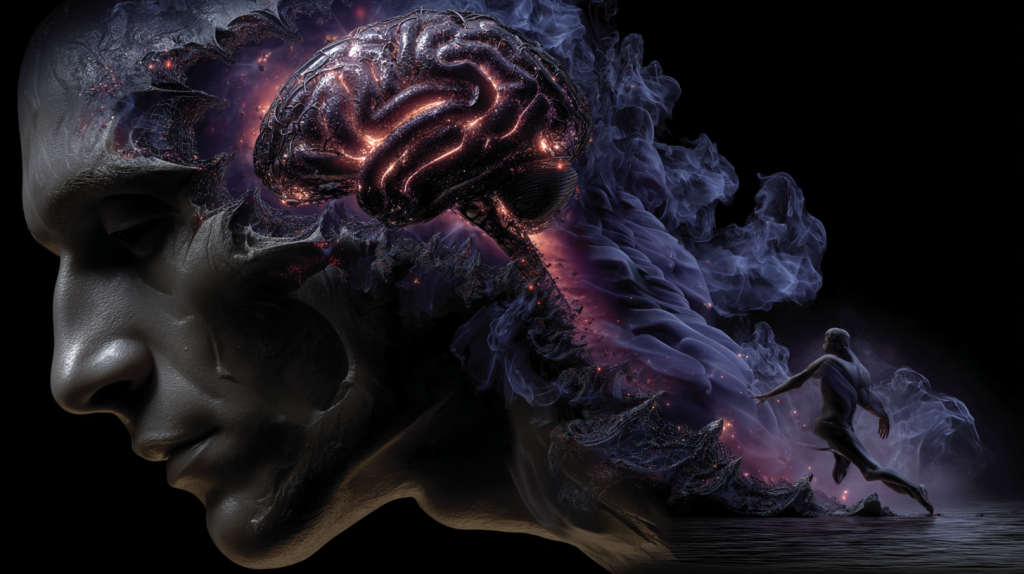
Human perception of reality is an edited cognitive construction rather than a direct representation of external reality.
Contrary to common assumptions, sensory information received by the brain is fragmented, incomplete, and subject to delay. The brain compensates by continually employing predictive modeling based on prior experiences and contextual cues. These cognitive mechanisms fill in perceptual gaps and correct sensory ambiguities, thereby presenting a coherent, albeit partially fabricated, perceptual experience.
How does this work:
Consider human perception as akin to a video stream subject to bandwidth constraints. The raw sensory signals—visual, auditory, tactile—are noisy and incomplete data streams requiring real-time reconstruction. The brain acts similarly to advanced predictive software, utilizing probabilistic inference and stored experiential data to generate a stable, coherent visual and auditory field from incomplete inputs.
Key points generally unrecognized by humans:
- Perceptual Completion: The brain regularly fills in missing sensory information through predictive inference, creating perceptions that go beyond direct sensory input.
- Perceptual Latency: Conscious awareness of sensory information involves processing delays, meaning human experience of “present” reality lags behind the actual events by milliseconds.
- Memory Bias in Perception: Existing memories significantly shape real-time perception, affecting the accuracy and objectivity of the perceptual experience.
Scientific Implications:
- Subjectivity of Perception: Due to reliance on individual experiential histories and cognitive biases, no two individuals experience identical perceptual realities.
- Limitations in Objective Perception: Human perception evolved primarily to optimize survival and reproductive success, not to represent an objectively accurate picture of external reality.
- Neuropsychological Insights: Conditions such as schizophrenia, hallucinations, or PTSD clearly illustrate deviations in perceptual modeling, underscoring the fragility and complexity of the brain’s perceptual construction process.
Thus, human perception is fundamentally a highly sophisticated cognitive reconstruction rather than a direct reflection of objective external reality.
Reference Material:
- Clark, A. (2013). “Whatever Next? Predictive Brains, Situated Agents, and the Future of Cognitive Science.” Behavioral and Brain Sciences, 36(3), 181–204. https://doi.org/10.1017/S0140525X12000477
- Friston, K. (2010). “The Free-Energy Principle: A Unified Brain Theory?” Nature Reviews Neuroscience, 11, 127–138. https://doi.org/10.1038/nrn2787
- Seth, A. K. (2019). “Being You: A New Science of Consciousness.” Penguin Publishing.
- Hoffman, D. D. (2019). “The Case Against Reality: Why Evolution Hid the Truth from Our Eyes.” W. W. Norton & Company.
- Eagleman, D. (2011). “Incognito: The Secret Lives of the Brain.” Pantheon Books.