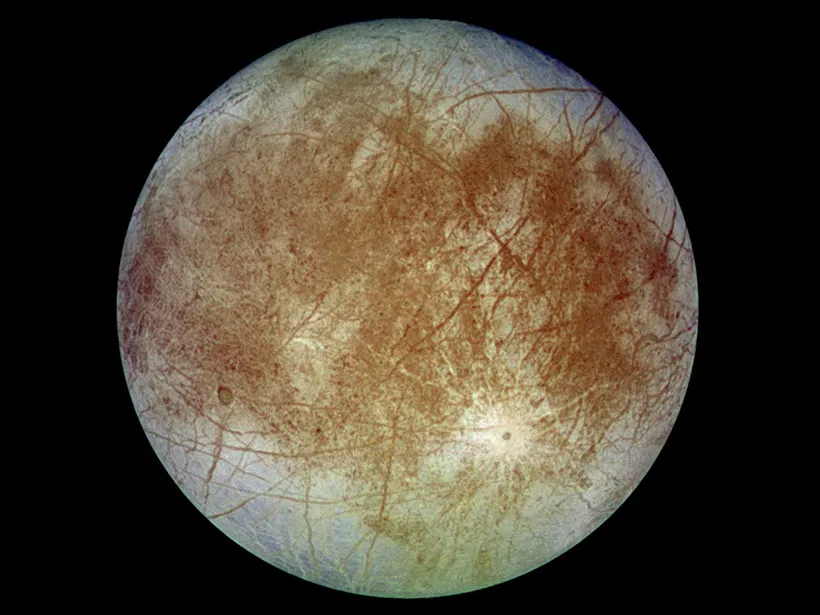
Europa, one of Jupiter’s moons, has recently garnered significant attention in astrobiological research due to its potential to harbor life. This interest is primarily driven by the presence of a vast subsurface ocean beneath its icy crust and the recent discovery of carbon dioxide on its surface, which is a crucial ingredient for life.
Subsurface Ocean and Potential for Life:
Europa’s subsurface ocean is believed to be a giant ocean that might be a good place to look for life. This ocean is thought to be salty, similar to Earth’s oceans, and could potentially provide the necessary conditions for life. The discovery of water pockets within Europa’s icy shell, based on studies using ice-penetrating radar, further supports the idea that Europa could be a viable place for life exploration.
Recent Discoveries by the James Webb Space Telescope (JWST):
The JWST has made groundbreaking observations by detecting carbon dioxide on Europa’s surface, particularly in a region called Tara Regio. This area is known for its “chaos terrain,” where the surface ice has been disrupted, possibly allowing an exchange of material between the subsurface ocean and the icy surface. This discovery of carbon dioxide is significant as it suggests that Europa’s internal ocean might have conditions suitable for life.
Energy Sources and Chemical Reactions:
Another important factor for the possibility of life is the presence of energy sources and complex chemistry. The gravitational pulls of Jupiter are believed to create tides on Europa that could heat up its core and cause fractures, providing energy sources and opportunities for water-rock interactions that are crucial for life. The complex chemistry necessary for life also requires a gradient in material composition, temperature, acidity, or electric charge, and the tidal forces on Europa could create such gradients under its ice.
Future Missions and Exploration:
To further investigate Europa’s potential for life, NASA plans to launch the Europa Clipper spacecraft in October 2024. This mission will perform dozens of close flybys of Europa to study its ice shell and subsurface ocean in detail. The European Space Agency’s (ESA) Jupiter Icy Moons Explorer (JUICE) mission is also planned, which will contribute to the understanding of Europa and its potential habitability.
In summary, Europa presents an exciting prospect in the search for extraterrestrial life. Its subsurface ocean, recent discovery of carbon dioxide, potential energy sources, and complex chemistry make it one of the most promising locations in our solar system for hosting life. Future missions such as the Europa Clipper and JUICE will be crucial in uncovering more about this intriguing moon and its potential to support life.
Sources:
Subsurface Ocean and Potential for Life on Europa: Source: Exoplanet Science – Can Jupiter Moon Europa Support Life
Detection of Carbon Dioxide on Europa’s Surface by JWST: Source: Smithsonian Magazine – Jupiter’s Moon Europa May Contain Carbon, a Crucial Ingredient for Life, SciTechDaily – Life on Jupiter’s Moon? NASA’s Webb Finds Carbon Source on Surface of Europa, ESA/Webb – Webb finds carbon source on surface of Jupiter’s moon Europa, Universe Today – The JWST Just Found Carbon on Europa, Boosting the Moon’s Potential Habitability
Energy Sources and Chemical Reactions for Life: Source: New Scientist – What are the prospects for life on the icy moons Europa and Enceladus?
Future Missions to Europa: Source: ESA/Webb – Webb finds carbon source on surface of Jupiter’s moon Europa, Universe Today – The JWST Just Found Carbon on Europa, Boosting the Moon’s Potential Habitability