Introduction
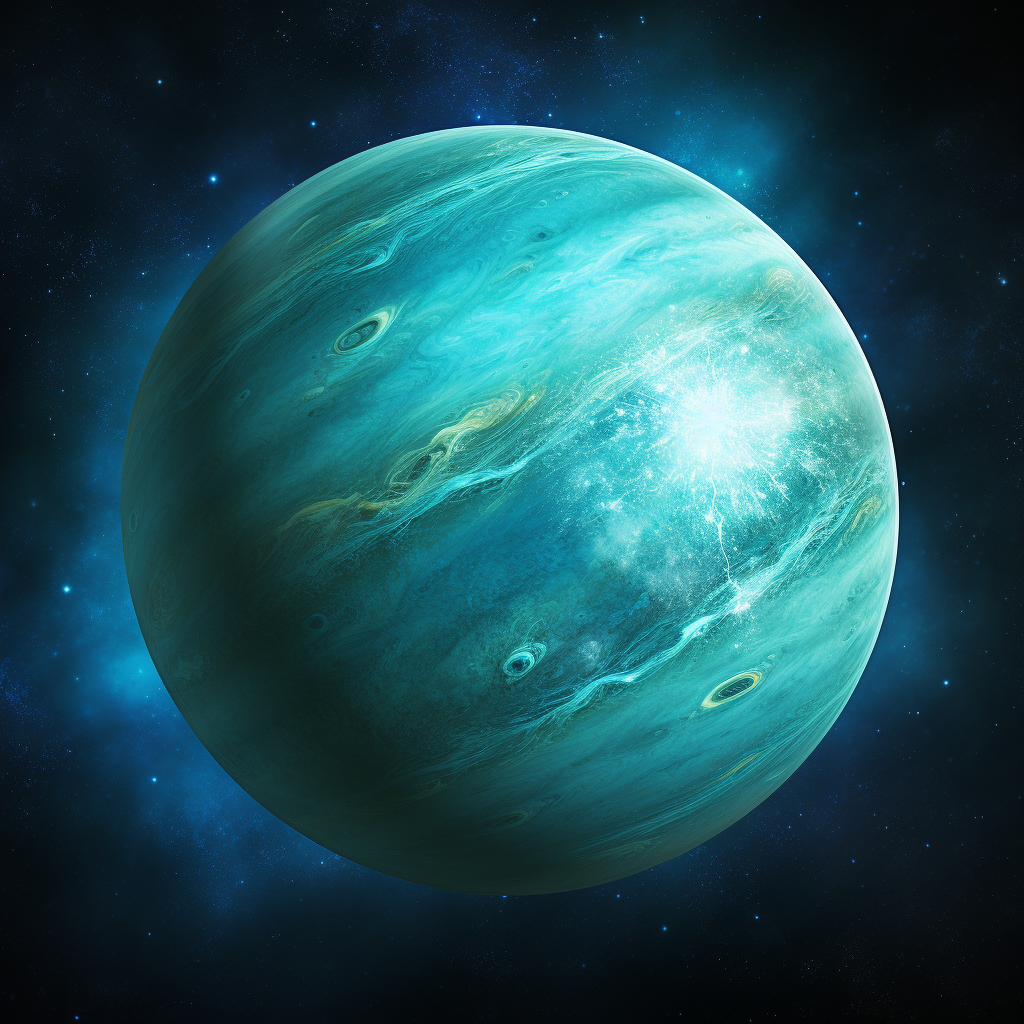
The celestial dance of Uranus’s moons is a cosmic ballet, choreographed by the laws of physics, and performed in the dark theater of space. As an expert astronomer, one cannot help but be captivated by the mysteries and intrinsic beauty that these natural satellites bestow upon the seventh planet from the Sun. In this article, we delve deep into the realms of Uranus to uncover the secrets of its moons, which serve as a testament to the complexity and diversity of our solar system.
Discovery and Exploration
Uranus, named after the ancient Greek deity of the sky, was discovered by William Herschel in 1781. It wasn’t until 1851 that the first two moons, Titania and Oberon, were identified by William Lassell. This marked the beginning of an era of discoveries that would eventually lead to a family of 27 known moons as of my last update, each named after characters from the works of William Shakespeare and Alexander Pope.
The Varied Family of Uranian Satellites
The moons of Uranus exhibit a wide range of characteristics in terms of size, composition, and orbital dynamics. They are typically categorized into three groups: the thirteen inner moons, the five major moons, and the nine irregular moons. Let’s explore these groups in detail.
The Inner Moons: Fragments of a Violent History
The thirteen inner moons are small and dark, suggesting they are likely composed of water ice contaminated with a dark material, possibly organic compounds. They orbit close to Uranus and are thought to have formed from the debris left over after collisions in the planet’s early history. The most notable among these include Miranda, Ariel, Umbriel, Titania, and Oberon.
Miranda: The Jigsaw Puzzle Moon
Miranda is perhaps the most fascinating of the inner moons, displaying the most diverse range of geological features within the Uranian system. It has giant canyons, towering ice cliffs, and a patchwork surface that looks like it has been pieced together from different worlds. This strange appearance might be the result of past tidal heating or even a violent collision that shattered the moon, with the pieces later reassembling into the mishmash we see today.
The Major Moons: The Giants in the Shadows
Among the five major moons, Titania is the largest, with a diameter of about 1,578 kilometers. It has a heavily cratered surface interspersed with long faults and canyons, indicating geological activity in the past. Oberon, slightly smaller, is also cratered and bears a prominent peak known as Mommur Chasma.
Ariel presents the youngest and most geologically complex surface, hinting at a relatively recent resurfacing event that erased older features. Umbriel remains the darkest and most enigmatic of the five, with its heavily cratered and ancient surface largely unchanged over the ages.
The Irregular Moons: Captured Wanderers
The nine irregular moons are a motley crew, likely captured by Uranus’s gravitational pull. They have highly inclined and retrograde orbits, suggesting they were once independent objects that strayed too close to the planet. Their irregular shapes and varied rotation periods further support this capture scenario.
Orbital Resonances and Interactions
The moons of Uranus engage in a complex gravitational dance. Some are locked in orbital resonances, where their orbits are linked through gravity’s rhythmical pull. This interaction can lead to tidal heating, where the gravitational tug-of-war flexes the moon’s interior, generating heat through friction.
The Role of Uranus’s Tilt
Uranus is unique with its extreme axial tilt of about 98 degrees, which influences the orbits of its moons. They essentially orbit above the planet’s equator, making them unique among the solar system’s natural satellites. This peculiar orientation could provide insights into past impacts that might have knocked Uranus onto its side.
Geological Mysteries and Cryovolcanism
Evidence of cryovolcanism, where icy materials rather than molten rock are expelled from a moon’s interior, can be seen on several Uranian moons. Ariel and Titania, with their relatively smooth surfaces and few impact craters, may still be geologically active, with icy lava shaping their landscapes.
The Atmospheres of the Moons
Most of Uranus’s moons are too small and too cold to maintain substantial atmospheres. However, some, like Titania, might possess transient atmospheres when their surfaces are warmed by the distant Sun, causing frozen materials to sublimate into gas.
The Ring-Moon System
The discovery of Uranus’s rings in 1977 also highlighted the role of its moons in maintaining these rings. The inner moons, particularly, act as shepherds, their gravity defining the rings’ sharp edges and influencing the distribution of ring particles.
Future Missions and Unknowns
Despite Voyager 2’s brief flyby in 1986, much remains unknown about the Uranian system. Future missions could reveal more about the interior composition of the moons, their potential for subsurface oceans, and their evolutionary history. For instance, determining the exact nature of Miranda’s peculiar surface or confirming cryovolcanism would provide invaluable insights into the processes shaping the outer solar system’s icy worlds.
Conclusion
The moons of Uranus are a diverse and intriguing collection of worlds. From the geological patchwork of Miranda to the dark, somber Umbriel, they offer a glimpse into the dynamic processes at play in the colder reaches of our neighborhood. Their study not only enriches our understanding of the solar system but also fuels the human spirit of exploration, propelling us to seek out the undiscovered and understand the cosmos in all its splendor.
As astronomers peer into the depths of space, Uranus’s moons stand as silent sentinels, their mysteries yet to be fully unraveled. They are a constant reminder of how much we have learned and how much is still out there, waiting to be discovered. In this eternal quest for knowledge, each discovery is a note in the grand symphony of the universe, a symphony in which Uranus’s moons play a crucial and enigmatic role.