Audio created using Google's Notepad LM link here.
What It Is
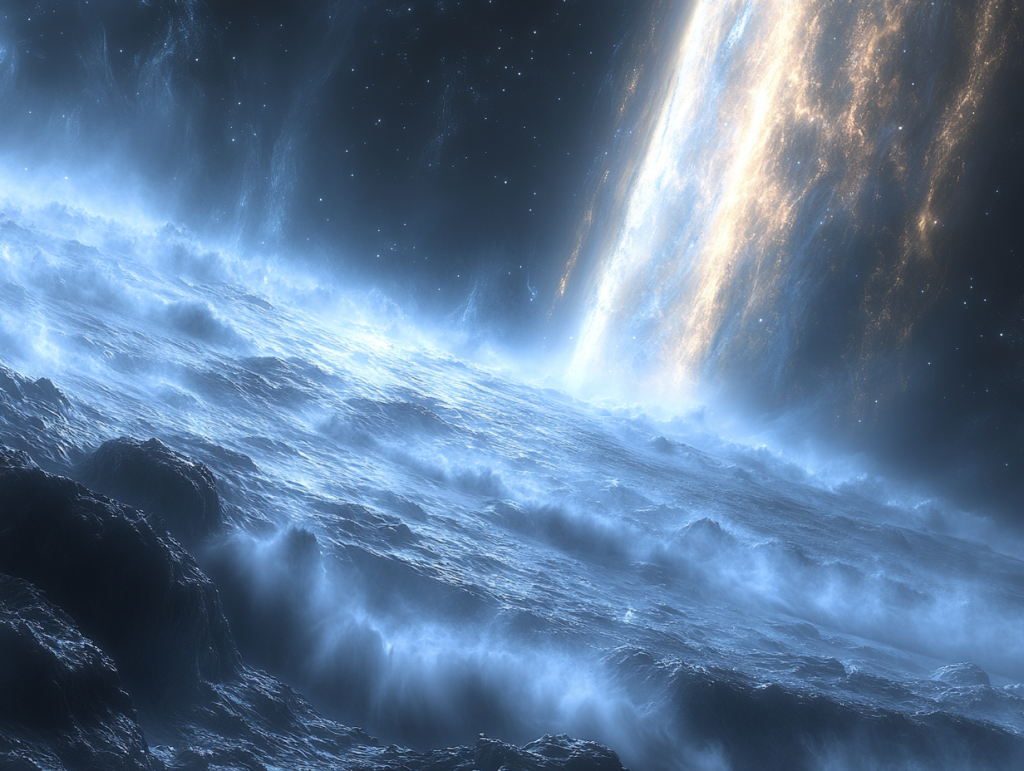
Deep inside Jupiter and Saturn, extreme temperatures and pressures can cause helium to separate from hydrogen and condense into droplets. These droplets then “rain” down toward the planet’s interior. Scientists call this phenomenon helium rain.
- Composition of Gas Giants:
- Jupiter and Saturn are mostly hydrogen and helium. Under ordinary Earth-like conditions, these gases mix well and remain gaseous.
- Inside these planets, however, the pressures skyrocket to millions of times Earth’s atmospheric pressure, and temperatures climb beyond thousands of degrees Celsius.
- Phase Separation:
- Under such intense conditions, helium can become so dense that it no longer stays dissolved in hydrogen.
- Think of it as what happens when oil separates from water—if you leave them undisturbed, they’ll form distinct layers. On Jupiter and Saturn, helium “drops” out of the fluid hydrogen.
- Helium Rain:
- Once helium separates into dense droplets, gravity draws them inward. They “rain” down through the hydrogen layers toward the planet’s core.
- As these droplets descend, they release heat. This extra heat affects atmospheric dynamics and can slightly alter the planet’s observed luminosity or energy balance.
Why It Matters
- Energy Output: Gas giants like Jupiter radiate more energy than they receive from the Sun. Helium rain might partially explain where this extra energy comes from—each droplet’s fall releases heat, which can drive the planet’s weather patterns.
- Planetary Evolution: Over billions of years, the helium “rained out” of the hydrogen upper layers may change how the planet’s interior is layered, affecting its temperature distribution, magnetic field, and even the planet’s size.
- Clues to Exoplanets: Studying helium rain in Jupiter and Saturn helps us understand similar processes that might happen on massive exoplanets around other stars, giving insight into how common or uncommon such phenomena might be throughout the universe.
An Analogy
Imagine you have a gigantic pot of soup on the stove (representing the hot hydrogen-helium mixture). If parts of the soup (helium) become heavier and sink, they effectively carry heat down with them as they fall and distribute it throughout. That heat can cause new currents and turbulence, changing the “weather” in the soup pot. In Jupiter’s case, you’re just dealing with pressures and temperatures beyond anything we experience on Earth—turning this soup-sinking analogy into an extreme cosmic event.
How Confirmed Is It?
Researchers have run high-pressure experiments on hydrogen-helium mixtures and used data from spacecraft like Cassini (for Saturn) and Juno (for Jupiter) to build models that strongly support helium rain. However, the conditions inside these planets are so difficult to replicate or directly measure that some aspects remain theoretical. Scientists continue to refine models and look for gravitational or magnetic field signatures that might confirm helium rain’s extent and impact.
In Summary
- Helium rain is a process by which helium separates from hydrogen under enormous pressure and temperature inside giant planets, forming droplets that “rain” inward.
- It’s suspected to account for some of the extra heat gas giants emit, playing a role in their atmospheric and internal evolution.
- Though scientists have hypothesized and partially studied this phenomenon, it’s rarely discussed outside specialized circles.
References
- https://www.aanda.org/articles/aa/full_html/2024/09/aa50629-24/aa50629-24.html
- NASA’s Juno Mission on Jupiter’s Interior