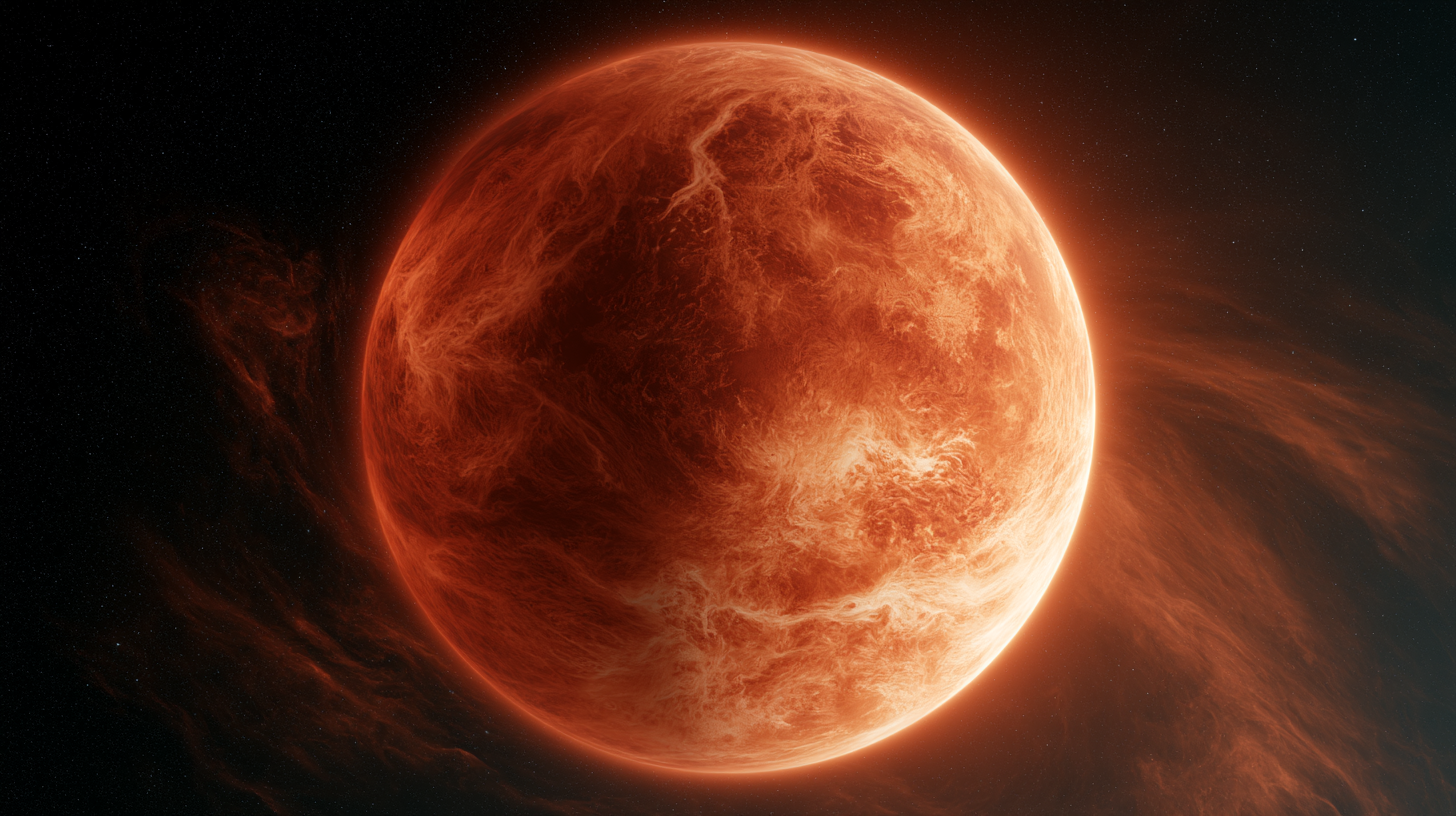
Atmospheric Dynamics and Climate Evolution on Venus: Implications for Comparative Planetology
Abstract
The climate and atmospheric evolution of Venus constitute a crucial case study in planetary science, offering insights into runaway greenhouse processes, atmospheric chemistry, and planetary habitability. This article evaluates state-of-the-art observations and modeling efforts to reconstruct the evolutionary pathways leading to Venus’s current climate, characterized by extreme surface temperatures and a dense, sulfuric acid-laden atmosphere. By analyzing isotopic data, cloud dynamics, and geophysical constraints, it situates Venus within the broader context of comparative planetology, highlighting uncertainties in early atmospheric conditions and the implications for terrestrial planet habitability trajectories. This analysis challenges simplified assumptions of atmospheric stasis and argues for complex feedbacks driving Venus’s transition from a potentially temperate environment to its extant hostile state.
Introduction
Venus’s atmospheric evolution poses an enduring challenge for planetary scientists aiming to decipher how terrestrial planets develop climate systems under varied initial and boundary conditions. Despite its proximity and Earth-like size, Venus’s atmosphere resembles an extreme outlier: a surface pressure of ~92 bars, surface temperatures exceeding 735 K, and an atmosphere dominated by CO2 with dense sulfuric acid clouds. Understanding how Venus evolved from any past habitable conditions to its modern hellish climate holds broader significance for assessing the fraction of Earth-sized exoplanets that might harbor life or experience runaway greenhouse states. This discussion synthesizes contemporary observations from missions such as ESA’s Venus Express and JAXA’s Akatsuki, integrated with advances in atmospheric modeling and isotopic tracing, to articulate a comprehensive view of Venus’s atmospheric dynamics and climate evolution.
Venus’s Present Atmospheric State and Dynamics
Venus’s atmosphere is notable not only for its chemical composition but also for its dynamic phenomena. The atmosphere is over 96% carbon dioxide, with minor constituents such as nitrogen (~3.5%), sulfur dioxide, and traces of water vapor. Surface pressure averages 92 bars, comparable to pressures experienced nearly one kilometer beneath Earth’s oceans, fostering a supercritical CO2 environment near the surface. The temperature-pressure profile exhibits a strong greenhouse effect far exceeding terrestrial analogues. Despite such extreme surface conditions, Venus exhibits remarkable meteorological phenomena, including superrotation—winds in the upper atmosphere circulating at speeds up to 100 m/s, completing a revolution around the planet within four Earth days. This superrotation contrasts with Venus’s slow retrograde rotation period of 243 Earth days, and its mechanism remains an active field of investigation.
Cloud layers between roughly 48 and 70 kilometers altitude consist predominantly of concentrated sulfuric acid aerosols, forming complex photochemical cycles driven by solar UV radiation. These clouds reflect about 75% of incident solar radiation, contributing to Venus’s high albedo. The upper atmosphere’s composition and circulation provide insights into vertical and horizontal transport processes that maintain cloud layer stability and relate to the depletion of water and other volatiles at lower altitudes. Observations indicate strong latitudinal temperature gradients at cloud tops, with polar vortices exhibiting dynamic structures, indicating an intricate interplay between radiative forcing, chemical processes, and atmospheric dynamics.
Isotopic Evidence and Constraints on Atmospheric Evolution
Isotopic ratios serve as a crucial diagnostic tool for reconstructing Venus’s atmospheric history. Measurements of deuterium to hydrogen (D/H) ratios in the Venusian atmosphere reveal enrichment factors approximately 100 times that observed on Earth. Elevated D/H ratios typically signify significant hydrogen escape over geological timescales, pointing to the loss of large quantities of water. This suggests the presence of an early Venusian ocean or at least substantial surface or atmospheric water reservoirs during Venus’s formative epochs.
The uncertainties in the initial water inventory and outgassing rates, however, introduce complexities. Variation in solar EUV flux over the Sun’s main sequence lifespan affects escape efficiency, with enhanced UV radiation during early epochs plausibly accelerating Venus’s water loss via hydrodynamic escape. Conversely, uncertainty remains about the timescale over which Venus shifted from a water-rich state to its current desiccated condition. Models vary in indicating durations from 100 million years to more than a billion years, reflecting differences in assumptions about volcanic resurfacing, atmospheric chemistry, and planetary magnetic field presence.
Measurements of noble gas isotopes such as argon and xenon further contribute constraints. Elevated ^40Ar concentrations imply substantial radiogenic degassing, indicative of ongoing volcanic activity potentially coupling interior processes with atmospheric evolution. Meanwhile, xenon isotope abundances suggest complex fractionation histories, possibly connected to early atmospheric escape mechanisms or accretionary sources. These isotopic datasets collectively constrain models of atmospheric outgassing, escape, and surface-atmosphere interactions essential for reconstructing Venus’s climatic trajectory.
Mechanisms Driving Venus’s Climate Transition
A long-standing question is how Venus diverged so dramatically from Earth despite similarly terrestrial conditions during the planets’ formative epochs. The theory of a runaway greenhouse effect is central. Initially, solar flux impinging upon early Venus may have been sufficiently low to allow liquid water to persist on the surface. However, as the Sun brightened over the last 4 billion years, water vapor—a potent greenhouse gas—would have increasingly augmented surface temperatures. This feedback cycle accelerated evaporation, raising atmospheric water vapor concentrations and eventually leading to the dissolution or escape of surface water completely.
Advanced three-dimensional coupled climate-chemistry models of paleo-Venus simulate these feedbacks, showing that increased insolation combined with volcanic outgassing could trigger a moist greenhouse state. In this state, the stratosphere becomes saturated with water vapor, facilitating photodissociation and subsequent hydrogen escape to space. As water is lost, carbon dioxide dominates atmospheric composition, reinforcing the greenhouse effect through line broadening and collision-induced absorption.
Volcanism likely exerted a dual influence by replenishing atmospheric volatiles and injecting sulfur species, which catalyze sulfuric acid cloud formation and influence atmospheric opacity. However, continuous resurfacing episodes observed suggest volcanic activity may be episodic rather than constant, modified by mantle convection and lithospheric recycling processes unique to Venus’s stagnant-lid tectonics.
An unintended implication of this runaway greenhouse framework is that Venus’s climate may have resided near a tipping point for extensive periods, and modest variations in volcanic activity, solar output, or orbital parameters could have amplified climate transitions. This underscores the sensitive dependence of terrestrial planet habitability on initial volatile inventories and feedback control mechanisms.
Comparative Perspectives with Earth and Mars
Venus’s climate evolution bears directly on comparative planetology, particularly when juxtaposed with Earth and Mars, the other terrestrial planets in the inner Solar System. Earth retained substantial oceans and a nitrogen-oxygen atmosphere conducive to complex life, while Mars lost most of its atmosphere and surface water, becoming a cold, arid world. Venus’s trajectory illustrates a distinct pathway characterized by the interplay of solar irradiation and atmospheric composition leading to greenhouse amplification.
Crucially, early Earth and Venus likely shared similar volatile inventories post-accretion, but marginal differences in orbital parameters or early atmospheric chemistry may have steered them onto divergent climatic paths. The presence of a robust magnetic field on Earth may have mitigated atmospheric erosion by solar wind, a protection Venus lacks today. Planetary rotation rates also influence atmospheric superrotation and heat redistribution, affecting surface temperature gradients and climate stability.
Mars, conversely, offers a contrasting scenario of atmospheric loss and cooling, likely due to lower gravity, lack of sustained volcanic activity, and early magnetic field loss. These three planets exemplify a spectrum of terrestrial planet climates controlled by a complex matrix of initial assembly conditions, solar forcing, internal geodynamics, and atmospheric processes.
Challenges and Future Directions in Venusian Climate Research
Despite significant advances, understanding Venus’s climate evolution remains hampered by several fundamental challenges. One key limitation is the lack of in situ data from atmospheric descent probes and surface stations, which has persisted since the Soviet Venera missions decades ago. Uncertainties in the tropospheric chemistry and cloud microphysics also limit the fidelity of atmospheric general circulation models.
Recent missions such as the European Space Agency’s EnVision (proposed for 2030s) and NASA’s DAVINCI+ and VERITAS will prioritize high-resolution radar imaging, atmospheric composition analysis, and surface characterization. These datasets are expected to refine understanding of volcanic resurfacing chronology and volatile cycling.
The potential discovery of trace gases such as phosphine, or other biosignature candidates in the upper cloud layers, has sparked both interest and controversy, underscoring the need for cautious interpretation of spectroscopic data amid observational noise. A better grasp of Venusian sulfide and sulfur chemistry may elucidate complex atmospheric cycles and their climatic ramifications.
Integration of isotopic data with evolutionary climate models and laboratory experiments on sulfuric acid aerosols and high-pressure supercritical CO2 environments constitutes a promising pathway. Understanding Venus also demands interdisciplinary approaches that link astrophysics, geochemistry, atmospheric science, and planetary geology in a comprehensive framework capable of capturing Venus’s unique system dynamics.
Broader Implications for Exoplanetary Habitability
Venus’s atmospheric history informs the search for habitable worlds beyond the Solar System by illustrating the potential climatic and atmospheric outcomes for Earth-sized planets orbiting sun-like stars. Given the demographics of exoplanet discoveries to date, which indicate many terrestrial candidates in close-in orbits subject to high stellar irradiance, Venus-like runaway greenhouse states may be common.
The “Venus zone” concept, delineating orbital regions where insolation drives runaway greenhouse conditions, helps contextualize planetary habitability beyond simplified habitable zone definitions. The interplay of stellar type, planetary atmosphere retention, and volatile inventories complicates predictions of surface conditions and atmospheric compositions.
Anticipated direct atmospheric characterization of rocky exoplanets by upcoming telescopes such as the James Webb Space Telescope and future missions will benefit from Venus as a natural laboratory, refining spectral templates and models for identifying greenhouse effects, atmospheric escape signatures, and cloud compositions.
Ultimately, Venus’s climatic evolution underscores the diversity of planetary outcomes dictated by factors beyond simple orbital position, emphasizing the need for nuanced models incorporating planetary geophysics and atmospheric feedbacks in evaluating exoplanet habitability.
References
- Esposito, L. W., Knollenberg, R. G., Marov, M. Y., Toon, O. B., & Turco, R. P. (1983). Sulfur dioxide on Venus: Evidence for atmospheric variability. Science, 220(4598), 1077–1079.
https://ui.adsabs.harvard.edu/abs/1983vens.book..484E/abstract - Way, M. J., et al. (2016). Was Venus the first habitable world of our solar system? Geophysical research letters, 43(16), 8376–8383.
https://pmc.ncbi.nlm.nih.gov/articles/PMC5385710/ - Grinspoon, D. H. (1993). Implications of the deuterium/hydrogen ratio for the volatile inventory of Venus, Earth, and Mars. Nature, 363(6427), 428–431.
https://doi.org/10.1038/363428a0 - L. Trompet, S. Robert, A. Mahieux, F. Schmidt, J. Erwin and A. C. Vandaele, November 2020, Phosphine in Venus’ atmosphere: Detection attempts and upper limits above the cloud top assessed from the SOIR/VEx spectra
https://www.aanda.org/articles/aa/full_html/2021/01/aa39932-20/aa39932-20.html